Seed Catcher for Bird Feeder: 4 Products Compared

Affiliate disclosure: Some links on this page are affiliate links. If you buy through them we earn a small commission at no extra cost to you. This never influences which products we recommend — we only suggest things we'd buy ourselves. Product prices and availability are accurate as of the date published and are subject to change. Always check Amazon for current pricing before purchasing. Learn more.
Quick Picks

Droll Yankees Classic Sunflower Seed Bird Feeder, 20-Inch
Ring Pull Advantage lid removes with one hand for fast, mess-free refilling
Check Price
Perky-Pet 16 Inch Transparent Squirrel Baffler for Bird Feeders - Keep Squirrels
Clear dome lets you watch birds
Check Price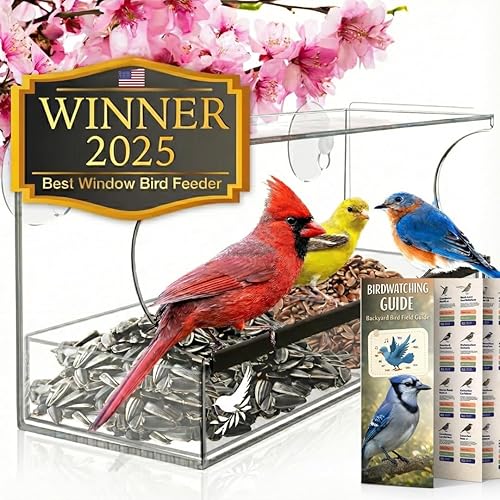
Nature's Hangout Window Bird Feeder with Strong Suction Cups and Seed Tray
Clear acrylic mounting brings birds within inches of indoor viewers , best close-up wildlife experience
Check PriceThe ground under a bird feeder tells you everything about how well it’s working. If you’re finding a spreading ring of hulls, husks, and rejected seed every morning, the feeder is doing its job but your lawn, deck, or patio is paying for it. A seed catcher addresses exactly that problem, and depending on your setup, it can be a tray attached to the feeder itself, a dome baffle above it, or simply a feeder design that limits scatter in the first place. This guide covers four products that solve the seed-spillage problem from different angles. Two are feeders built to reduce waste by design. Two are accessories that work with feeders you may already own. Before you buy, it’s worth spending a few minutes on our Bird Feeders & Baths hub, which covers the full range of feeder types and accessories in one place.
What to Look For in a Seed Catcher Setup
Tray vs. Dome vs. Built-In Design
The three main approaches each have a different use case. A tray or catch basin mounts below the feeder and collects falling seed and hulls. Simple, effective, low cost. The downside is that collected seed gets wet, can mold, and requires regular cleaning. If you forget about it for a week in July, you’ll know. A dome baffle sits above the feeder on a hanging cable. It blocks squirrels from climbing down from above and, if positioned correctly, also deflects rain from the feeder. Some designs do double duty as seed catchers when used on pole systems, but most are primarily squirrel barriers. A built-in design is the cleanest solution. Feeders engineered with tight port tolerances and weight-activated closures scatter far less seed to begin with. Less seed on the ground means less cleanup, less waste, and fewer rats and deer drawn in. (If deer pressure is a separate issue on your property, our Deer Out Deer Repellent review is worth reading alongside this one.)
Capacity and Refill Frequency
This matters more than most buyers realize before purchasing. A feeder with a 1-pound capacity will need refilling every day or two during fall migration or a hard winter with consistent bird traffic. A 5-pound feeder buys you a week. If your feeder is on a post at the far end of your property rather than just off the back porch, that difference is real.
Squirrel Deterrence
A seed catcher solves one problem. Squirrels create a different one, and if you don’t address both together, you’ll still be cleaning up scattered seed every morning because squirrels rake feeders to find preferred seeds. Any feeder setup without some form of squirrel management is incomplete.
Materials and Durability
Polycarbonate holds up better than standard acrylic in temperature swings. Clear plastic domes and trays that aren’t UV-stabilized will yellow and crack after two or three seasons of sun exposure. It’s a small thing until it isn’t.
Top Picks
Best Entry-Level Feeder: Droll Yankees Classic Sunflower Seed Bird Feeder, 20-Inch
Currently around $30 on Amazon. Droll Yankees has been making tube feeders in Rhode Island since 1969, and this one is about as straightforward as feeders get. The 20-inch polycarbonate tube is UV-stabilized, which means it won’t yellow or crack the way cheaper imported tubes do. Six feeding ports handle multiple birds simultaneously. The Ring Pull Advantage lid lifts off with one hand for refilling, which sounds minor until you’re balancing a seed scoop in the other hand in November. The honest limitation is capacity. At 1 pound, you’re refilling frequently during peak season. More relevant to this guide, there’s no built-in seed tray and no squirrel deterrent. The feeder itself won’t solve your ground-mess problem without accessories. What it does give you is a well-made, American-manufactured starting point with a lifetime guarantee, which is more than most feeders at this price offer. If you’re new to feeding birds and want something reliable before spending more, this is where I’d start. Add a baffle separately, and consider a catch tray if your setup allows for one. Pairs with: The Perky-Pet dome below, or a pole-mounted baffle system.
Best Clear Dome Baffle: Perky-Pet 16 Inch Transparent Squirrel Baffler for Bird Feeders
Currently around $14 on Amazon. This is the classic solution to overhead squirrel access and partial rain protection. The 16-inch clear dome mounts above the feeder on your hanging cable and works on both hanging and pole-mount setups. Because it’s transparent, it doesn’t obstruct your view of the birds below. The limits are straightforward. Sixteen inches is adequate for most gray squirrels but may not discourage larger or more aggressive individuals that have learned to swing around it. The plastic will eventually yellow. And this is squirrel management, not a seed catcher per se. It reduces scatter by blocking squirrels from getting in and raking seed out, but it won’t catch what birds themselves drop. At $14, the price makes the limitations forgivable. This is the accessory you add to the Droll Yankees feeder above if you want a complete, functional setup without spending much.
Best Window Feeder for Close-Up Viewing: Nature’s Hangout Window Bird Feeder with Strong Suction Cups and Seed Tray
Currently around $30 on Amazon. This one operates differently from everything else in this guide. It mounts directly to a window via suction cups rated to hold for 12-plus months without repositioning, and the built-in seed tray is the seed catcher. Seed that falls from birds feeding at the ports lands in the tray rather than on the ground. The appeal here is proximity. Chickadees and nuthatches at 8 inches from your face, through glass. If you have children who are learning to identify birds, or if your outdoor space is limited to a balcony or small deck, the bird feeder for window experience is categorically different from a feeder at the end of the yard. (I’d also point you to our dedicated Bird Feeder For Deck guide if a deck or balcony is your primary feeding space.) Practical notes: birds take time to find and trust a new window feeder. Give it a week or two before concluding it isn’t working. Cleaning requires pulling the feeder off the glass, which is slightly more effort than a pole-mounted tray. The 4-plus cup capacity handles mixed seed well, and the award-winning design has held up under real-use reviews better than competing acrylic window feeders I’ve seen crack within a season. This is the pick for anyone feeding birds in a limited outdoor space or who wants the closest possible viewing experience.
Best All-In-One Squirrel-Proof Feeder: Squirrel Buster Plus Bird Feeder with Cardinal Ring
Currently around $55-65 on Amazon. This is the product I’d buy if I were starting over. The Squirrel Buster Plus uses a weight-activated shroud: when a squirrel grabs the feeder, its weight causes the outer cage to drop and cover the seed ports. No batteries. No electricity. No moving parts beyond the mechanism itself. The squirrel gets nothing and eventually stops trying. (I have run this for two seasons now against eastern gray squirrels that had previously defeated three other feeder designs. The record stands.) The 5.1-pound capacity means weekly refills at most, rather than daily. Six feeding ports with the cardinal ring accommodate everything from chickadees up to cardinals and larger. The adjustable weight sensitivity is the genuinely useful engineering feature: you can set the threshold to close for squirrels only, or tighten it enough to also exclude grackles and European starlings if you’re managing what species you’re feeding. That’s a decision worth making deliberately rather than by default. The weight calibration requires some trial and error to dial in correctly, and cleaning is more involved than a simple tube feeder. If you’re comparing this to the Droll Yankees, you’re spending roughly twice as much. What you’re getting for that is built-in squirrel exclusion and 5x the seed capacity. For anyone feeding birds seriously, that trade is straightforward. For comparison, I had previously run a Droll Yankees Flipper (motor-activated) before switching to passive weight mechanisms. The Squirrel Buster’s approach is simpler and has fewer failure points. If you’re also feeding peanuts or mealworms to attract specific species, see our guides on bird feeder for peanuts and bird feeder for mealworms for compatible setups.
How to Choose
If you want the simplest possible entry into bird feeding at low cost: The Droll Yankees tube feeder plus the Perky-Pet dome gives you a complete functional setup for around $44 total. It won’t deter determined squirrels entirely, but it will get you started. If you’re dealing with significant squirrel pressure and want to stop fighting it: The Squirrel Buster Plus is the straightforward answer. Spend the $60, set the weight threshold once, and the problem is largely handled passively. If your outdoor space is limited, or you want birds close to a window: The Nature’s Hangout window feeder is its own category. It doesn’t compete with pole-mounted feeders. It does something different and does it well. If you already have a feeder you like and just want to reduce ground mess: A catch tray that mounts to your existing pole or hanging cable is the first thing to try. The Perky-Pet dome is also worth adding if squirrels are a contributing factor to your scatter problem. The ground under a feeder will always have some debris. The question is whether it’s a manageable ring of hulls or a daily rake job. The right combination of feeder design and accessories makes a real difference, and more options across feeder types, poles, baths, and accessories are covered in our birds and wildlife resource section.
Frequently Asked Questions
Does a seed catcher actually work, or does it just move the mess?
A properly sized catch tray mounted directly below the feeder will collect a meaningful percentage of dropped seed and hulls instead of letting them fall to the ground. How well it works depends on tray diameter relative to the feeder’s footprint, and on whether the birds at your feeder are aggressive rakers (like house sparrows) or more deliberate feeders. You’ll still get some ground debris. The goal is reducing it, not eliminating it entirely.
How often do I need to clean a seed catch tray?
At minimum, every week during wet weather. Wet seed sitting in a tray will mold within a few days in warm conditions, and moldy seed is a real health risk to birds. In dry summer weather you may get away with every 10 to 14 days, but a quick check every few days is better practice. This is the maintenance cost of using a catch tray, and it’s worth factoring into your decision before buying.
Will a squirrel dome baffle also function as a seed catcher?
Not effectively. Dome baffles are designed to block squirrel access from above, not to catch falling seed below the feeder. A few designs marketed as dual-purpose exist, but in practice the dome position above the feeder doesn’t intercept seed that drops from bird activity at the ports. For seed catching, you want a tray below the feeder, not a dome above it.
Can I add a catch tray to any hanging feeder, or do I need a specific setup?
Most catch trays designed for hanging feeders attach via the same cable or chain as the feeder itself, using a hook-and-loop arrangement. Check the tray’s listed diameter against your feeder’s width before ordering. A tray that’s only an inch or two wider than the feeder catches very little. For a 20-inch tube feeder like the Droll Yankees, you want a tray with at least a 13 to 14-inch diameter, ideally more.
Why is there more seed debris on the ground after I refilled the feeder?
Two likely causes. First, if you’re using a mixed seed blend, birds will often pick out preferred seeds (sunflower, millet) and toss the rest. Switching to a single-seed fill reduces this dramatically. Second, fresh seed on top of an older, slightly stale layer at the bottom can cause birds to dig through the feeder more aggressively. Keeping the feeder from overfilling and rotating seed regularly reduces that behavior.