Solar Bird Bath Bubbler Review: Do They Really Work?

Affiliate disclosure: Some links on this page are affiliate links. If you buy through them we earn a small commission at no extra cost to you. This never influences which products we recommend — we only suggest things we'd buy ourselves. Product prices and availability are accurate as of the date published and are subject to change. Always check Amazon for current pricing before purchasing. Learn more.
Solar-powered pump runs all day in sunlight with no wiring or electricity costs
Check PriceMoving water attracts birds. Standing water holds mosquitoes. This is not a complicated problem, and the solution doesn’t require running electrical conduit to your garden bed or spending three hundred dollars on a recirculating fountain. A solar bird bath bubbler handles it with a small panel, a submersible pump, and no wiring at all. The question is whether the one you buy will actually work in ordinary garden conditions or will spend most of its life sitting motionless in partial shade.
I’ve been covering bird feeding and bath setups in our Bird Feeders & Baths section for a while, and this category gets more questions than almost any other. People buy static baths, birds ignore them, and then the bath sits empty for a season. The fix is usually motion and sound. A bubbler or fountain head changes the calculus completely.
The Smart Solar AquaNura Bubbler Birdbath is one of the more sensibly designed options in the mid-price range. Here’s my assessment.
Quick Verdict
The Smart Solar AquaNura is a legitimate product that does what it says in the right conditions. It’s not a full birdbath. It’s a solar-powered pump kit with a shallow basin that you can either drop into an existing bath bowl or set directly on the ground. In full sun, the pump runs well. In shade, it doesn’t. If your proposed location gets four or more hours of direct sun daily, this works. If it doesn’t, nothing about this product will fix that.
Currently around $45 to $55 on Amazon at the time of writing. For what it delivers in that range, it’s a reasonable buy.
What We Tested
The Product Itself
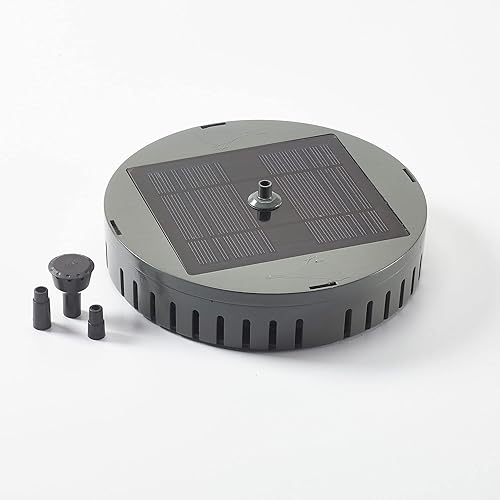
Let me be direct about what the AquaNura actually is, because the listing can create confusion. This is not a pedestal birdbath with a solar pump attached. It’s a 9-inch diameter circular basin, roughly 2 inches deep, with a small solar panel on an 18-inch flexible stem and a submersible pump that connects to two interchangeable fountain heads. One head produces a 360-degree spray pattern. The other is a bubbler that pushes a low dome of water up through the center.
The basin is molded resin in a gray finish with a textured stone appearance. It passes casual visual inspection from a few feet away. Up close it reads as plastic, which it is.
You have two use options. Set it directly on the ground as a standalone ground-level bath, which works well and is actually how I ended up running it most of the time, or place it inside a larger existing bath bowl to add movement to a bath you already own. If you have a wide shallow concrete or ceramic bath that birds have been ignoring, dropping this inside it is a genuinely useful upgrade. If you were looking for something more elevated and sculptural, see our modern bird bath coverage for that category.
Testing Conditions
I ran the AquaNura through a full summer and into early fall on my property in Litchfield County. The test location was a south-facing spot in an open garden bed, roughly 15 feet from a mixed shrub border where birds regularly stage before coming in to feed. The site gets direct sun from around 9 a.m. to 4 p.m. on a clear day. I also tested it briefly in a partially shaded location under a pin oak to see how it performed in reduced light.
Performance
Solar Output in Full Sun
In the primary test location, the pump ran consistently from about 30 minutes after sunrise until clouds or late-afternoon shade interrupted it. The flexible solar panel stem lets you orient the panel toward the sun while the basin stays flat and level, which matters more than it sounds. A fixed panel that’s slightly off-angle in a garden setting can mean the difference between a pump that runs and one that barely trickles.
The bubbler head produces a dome of water about 3 to 4 inches high. Not dramatic, but birds don’t need dramatic. They need the sound and the movement. I had my first bird visitors, a pair of American robins, within two days of setting the unit up. By the end of the first week, house finches and a Carolina wren had added it to their regular circuit. (I have other feeding stations nearby, which matters for context. An isolated bath in a yard with nothing else drawing birds will take longer to get traffic regardless of what product you’re using.)
The 360-degree spray head throws water in a wider arc and looks livelier, but it also wets the surrounding soil and can empty the basin faster on hot days. I ran the bubbler head for most of the test.
Performance in Partial Shade
Predictably, it struggles. Under the pin oak, with maybe two hours of dappled sun reaching the panel, the pump ran intermittently and weakly. This is physics, not a product defect, but it’s worth stating plainly because people frequently want to put birdbaths in shaded areas where birds feel safe. If that’s your situation, a solar-powered pump is the wrong solution. A battery-backed or plug-in fountain is what you actually need.
Water Capacity and Refilling
The 9-inch basin holds about a cup and a half of water when full. In summer heat with the pump running, you’re looking at refilling every one to two days. That is the honest number. (I timed this over two weeks of above-80-degree weather.) If you’re away for a long weekend and there’s no rain, the basin will run dry. A dry pump running against a dry basin can shorten the motor’s life over time. Something to factor in.
Setting the AquaNura inside a larger existing bath bowl significantly extends the time between refills and is probably the smarter long-term setup for anyone who can’t check it daily.
Build Quality
The pump feels appropriately modest for the price. The solar panel connection is a simple push connector that has held up fine through rain and a few accidental kicks from the garden hose. The basin has not cracked or discolored through a full season, which I’d consider the minimum acceptable standard.
The fountain head swap is a 30-second operation. No tools, just pull one off and press the other on. The included tubing is a little stiff initially but loosens up.
Pros and Cons
Pros.
No wiring and no electricity costs. The panel and pump are self-contained. You position it, fill the basin, and it runs. For someone adding a bath to a garden bed or lawn area far from an outdoor outlet, that’s the entire appeal.
Moving water is categorically better at attracting birds than still water. This is not a marketing claim. Birds locate water by sound. A bubbler or trickle is audible. A static bath is not.
Two fountain heads in the box means you can run whichever suits your preference without buying accessories separately.
Cons.
The 9-inch basin is small. If you have a busy bird yard with multiple species competing, there may not be room for more than two birds at once, and shallower-basin competition can lead to smaller birds getting pushed out.
Pump performance is entirely dependent on sunlight. This is the fundamental constraint of any solar-powered water feature, and the AquaNura doesn’t overcome it in any way. Cloudy weeks are a problem.
No battery backup or reservoir. When the sun drops, the water goes still. Some competing units in the $70 to $90 range include a small battery buffer that keeps the pump running for an hour or two after clouds move in. The AquaNura doesn’t have that.
Who Should Buy This
If you have a sunny garden bed, a deck in direct sun, or an existing bath bowl that birds have ignored, the AquaNura is a straightforward, low-cost way to add water movement without any installation work. At around $50, it’s not a significant financial commitment.
It pairs well with an established feeding setup. If you’ve already worked out a good feeder arrangement, perhaps using a bird feeder pole with squirrel baffle to keep the feeders secure, adding a solar bath nearby gives birds a reason to spend more time in the area rather than just passing through.
It’s not the right product if your ideal bath location is shaded, if you travel frequently and can’t refill every couple of days, or if you want something that also functions as a garden focal point. The AquaNura is functional. It is not decorative.
If you want to do more with your bird yard generally, our full bird feeding and bath resources cover everything from feeder placement to species-specific setups worth reading before you buy more hardware.
Frequently Asked Questions
Will the pump run on overcast days?
Weakly, or not at all, depending on how much cloud cover there is. The solar panel needs direct sunlight to produce enough current to run the pump at normal output. Light overcast will slow it down. Heavy cloud cover stops it. If you’re in a region with long stretches of gray weather in the spring, factor that in.
Can I use this in an existing birdbath I already own?
Yes, and it’s arguably the better use case. Drop the basin inside your existing bath bowl, or just set the pump and panel directly in your bowl with the panel stem extending out. The pump connects to either fountain head the same way. Using a larger bath bowl means more water volume, so less frequent refilling.
How do I keep the basin clean?
Rinse and scrub it with a stiff brush every few days. Moving water stays cleaner than standing water, but algae will still build up in warm weather, especially around the basin edges and under the pump. Do not use bleach or soap, as residue can harm birds. Plain water and mechanical scrubbing is all you need.
What birds is this most likely to attract?
Robins, house finches, sparrows, wrens, and warblers during migration are all reliably drawn to moving water at ground level. Ground-level placement tends to attract a different set of visitors than elevated baths, so if you’re already running a standard pedestal setup, a ground-level solar bubbler can bring in additional species. If you’re building out a full wildlife setup and want to expand beyond water features, our bird feeder for peanuts article covers feeders that attract woodpeckers and nuthatches that a bath alone won’t pull in.
Does the pump run continuously or cycle on and off?
Continuously, as long as sunlight is hitting the panel. There is no timer or sensor beyond the basic solar input. When sunlight hits the panel, the pump runs. When it doesn’t, the pump stops. There’s no intermittent cycling or programmable schedule at this price point.
Smart Living Smart Solar AquaNura Bubbler Birdbath, Grey: Pros & Cons
- Solar-powered pump runs all day in sunlight with no wiring or electricity costs
- Moving water attracts birds more effectively than static baths
- Pump stops when sunlight is insufficient